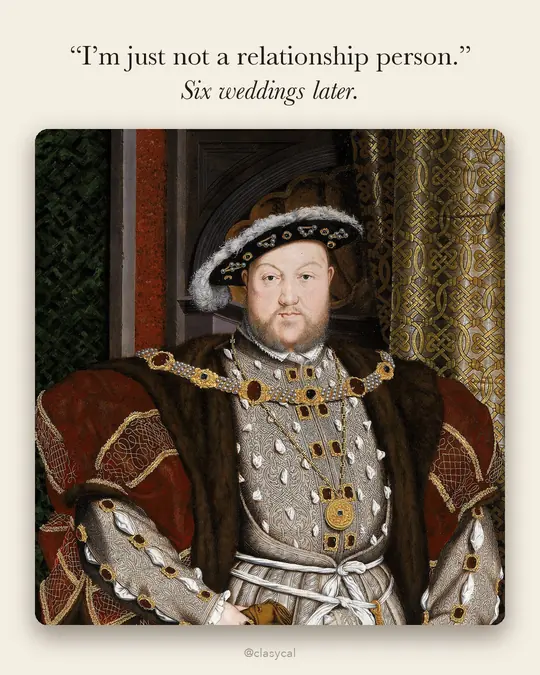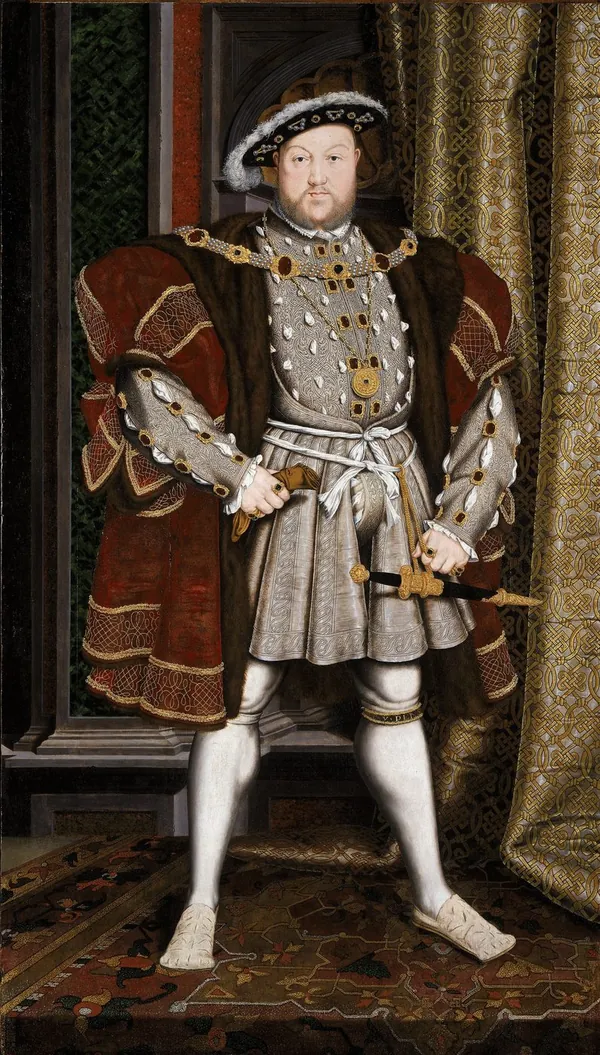
Close your eyes and picture Henry VIII. You're probably seeing the same image everyone sees: legs planted wide, shoulders as broad as a wardrobe, hands near his belt, staring you down like you've just questioned his divorce.
That image is no accident. It was designed. It was painted by one of the best artists of the 16th century, copied over and over, and handed out like a royal press kit. Henry VIII's portraits were, in a very real sense, propaganda.
The king hires the best
Hans Holbein the Younger was a German-born painter who had already made his name in Basel. By 1536 he was working for Henry as the King's Painter, and he gave the king the image that would define him for the next 500 years.
The timing matters. Henry had broken with the Pope in Rome, made himself head of the Church of England and gone through two marriages in rapid, dramatic succession. He had married Jane Seymour in May 1536, eleven days after the execution of Anne Boleyn. A king in that position needs to look very sure of himself.
The Whitehall Mural: Henry's power pose
In 1536–37 Holbein painted a life-size mural for the Privy Chamber at the Palace of Whitehall in London. It showed four people: Henry VIII and Jane Seymour in front, and behind them Henry's parents, Henry VII and Elizabeth of York, the founders of the Tudor dynasty. In the middle stood a stone block carved with a Latin inscription comparing the two kings and making it clear which Henry came out on top.
And in the center of it all: Henry, facing you head-on, feet apart, chest out, every inch the master of his kingdom.
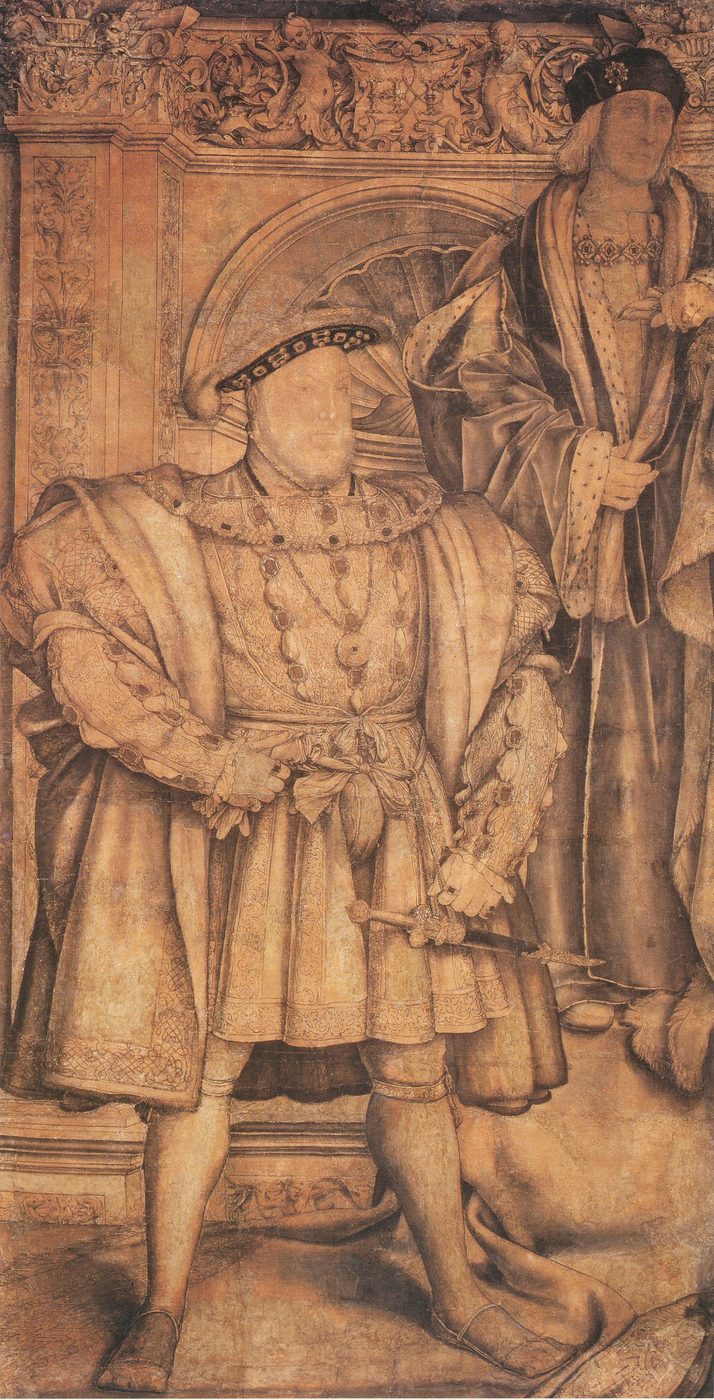
The mural itself no longer exists. It was destroyed when Whitehall Palace burned down in January 1698. What survives is a small copy made in 1667 by Remigius van Leemput for King Charles II, and part of Holbein's original full-size drawing, the cartoon, now in the National Portrait Gallery in London. The cartoon is pricked with tiny holes along the outlines: soot was pushed through them to transfer the design onto the wall.
Interestingly, in the cartoon Henry's head is turned at a three-quarter angle. In the finished mural, he faces you straight on. Somewhere between the drawing and the wall, the decision was made: no glancing aside. The king looks at you.
What the portrait leaves out
When Holbein painted the mural, Henry was in his mid-forties. Earlier in 1536 he had suffered a serious accident in the tiltyard, and his health problems, including painful ulcers on his legs, would trouble him for the rest of his life.
None of that is in the picture. The Henry on the wall is strong, broad and vigorous. And some of it is clever exaggeration:
- The legs. Comparisons with his surviving armor suggest Henry's legs were noticeably shorter than the long, straight legs Holbein painted.
- The shoulders. Heavily padded and widened by layers of rich fabric, they make him look almost square.
- The codpiece. Prominent. Very prominent. In a reign obsessed with producing a male heir, the message is not subtle.
The figure is built to look imposing. It's less a portrait of a man than a portrait of power.
Copy, paste, distribute
A mural in a private royal chamber can only impress the people who get into that room. So the image traveled. Henry encouraged copies of his likeness and gave them to friends and ambassadors, and nobles commissioned their own versions to show their loyalty.
That's why so many full-length portraits of Henry in this pose exist. The one at the top of this page, now in the Walker Art Gallery in Liverpool, is a copy after Holbein made by his workshop or followers. In an age without photography or TV, this was how most people knew what their king looked like: through a carefully approved, endlessly repeated official image. The 16th-century version of a profile picture you never change.
It worked for centuries. When Charles Laughton played the king in the 1933 film The Private Life of Henry VIII, he modeled his look on the Holbein portrait. Henry still looks like the version he approved.
Reality check: the armor
If the portraits are the press release, Henry's armor is the receipt. The Royal Collection holds a suit made for him around 1540, in which metal strips were added to expand the waist to a final measurement of about 138 cm, around 54 inches. The younger Henry, athletic and famously fond of jousting, was a very different shape. The portraits never really show that change. They freeze him in his prime-of-power pose.
When the propaganda went the other way: Anne of Cleves
Henry knew exactly how powerful portraits were, which makes one episode deliciously ironic. In 1539 he was looking for a fourth wife, and he sent Holbein to the German duchy of Cleves to paint Anne, the duke's sister.
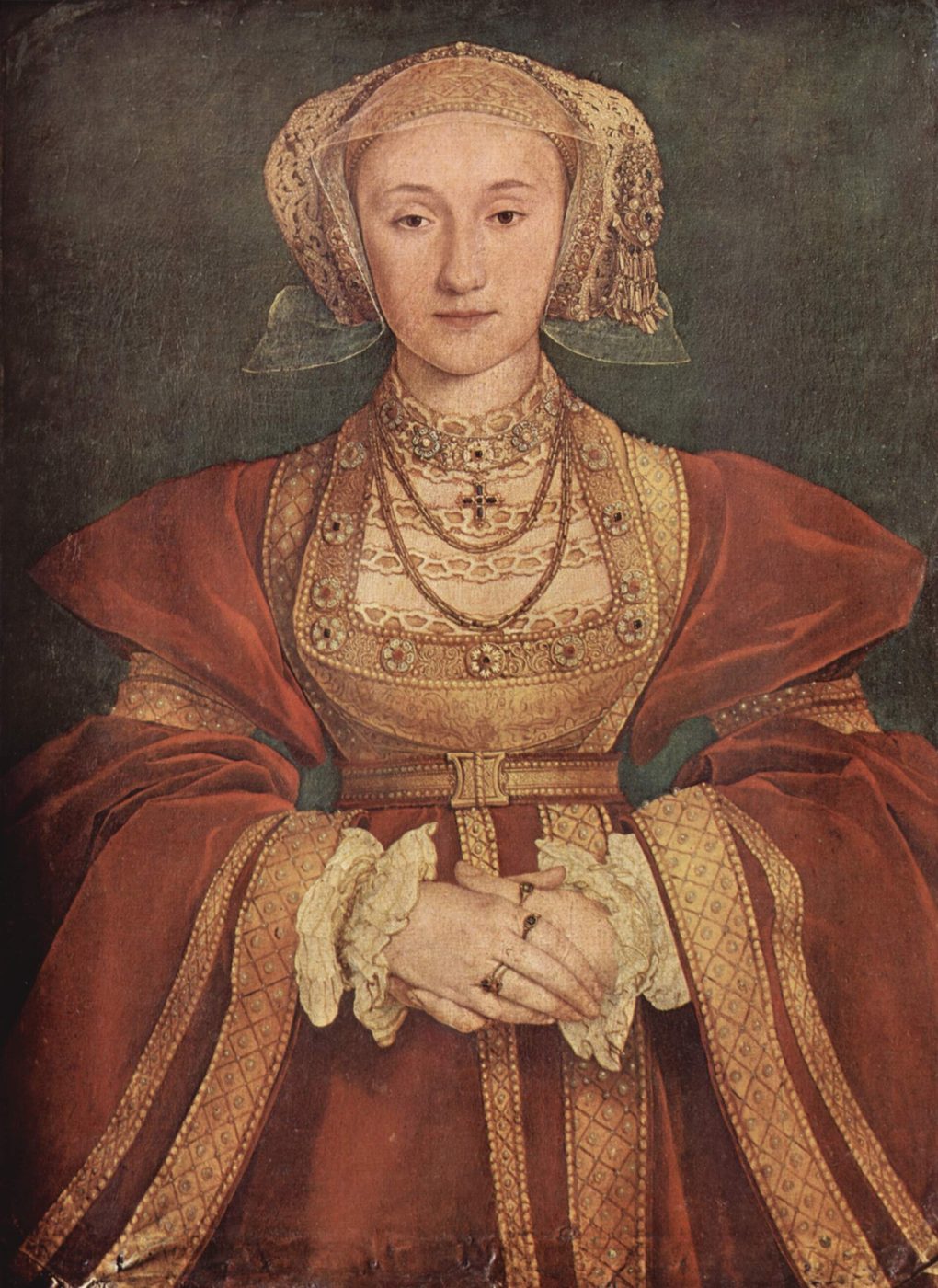
They married in January 1540. By July, the marriage had been annulled. According to Thomas Cromwell's later account, Henry told him after meeting Anne: "I like her not." Cromwell, who had pushed for the match, was executed that same summer, for reasons that went well beyond one awkward marriage.
A few myths need clearing up here. The famous insult calling Anne a "Flanders mare" doesn't appear in any record from her lifetime; it was first published by the historian Gilbert Burnet in 1679, more than a century later. And whether Holbein's portrait actually flattered her is still debated. Contemporaries considered Holbein a skilled likeness-maker, and many accounts before the wedding praised Anne's looks. Holbein, notably, kept working for the king.
The queen he kept in the picture
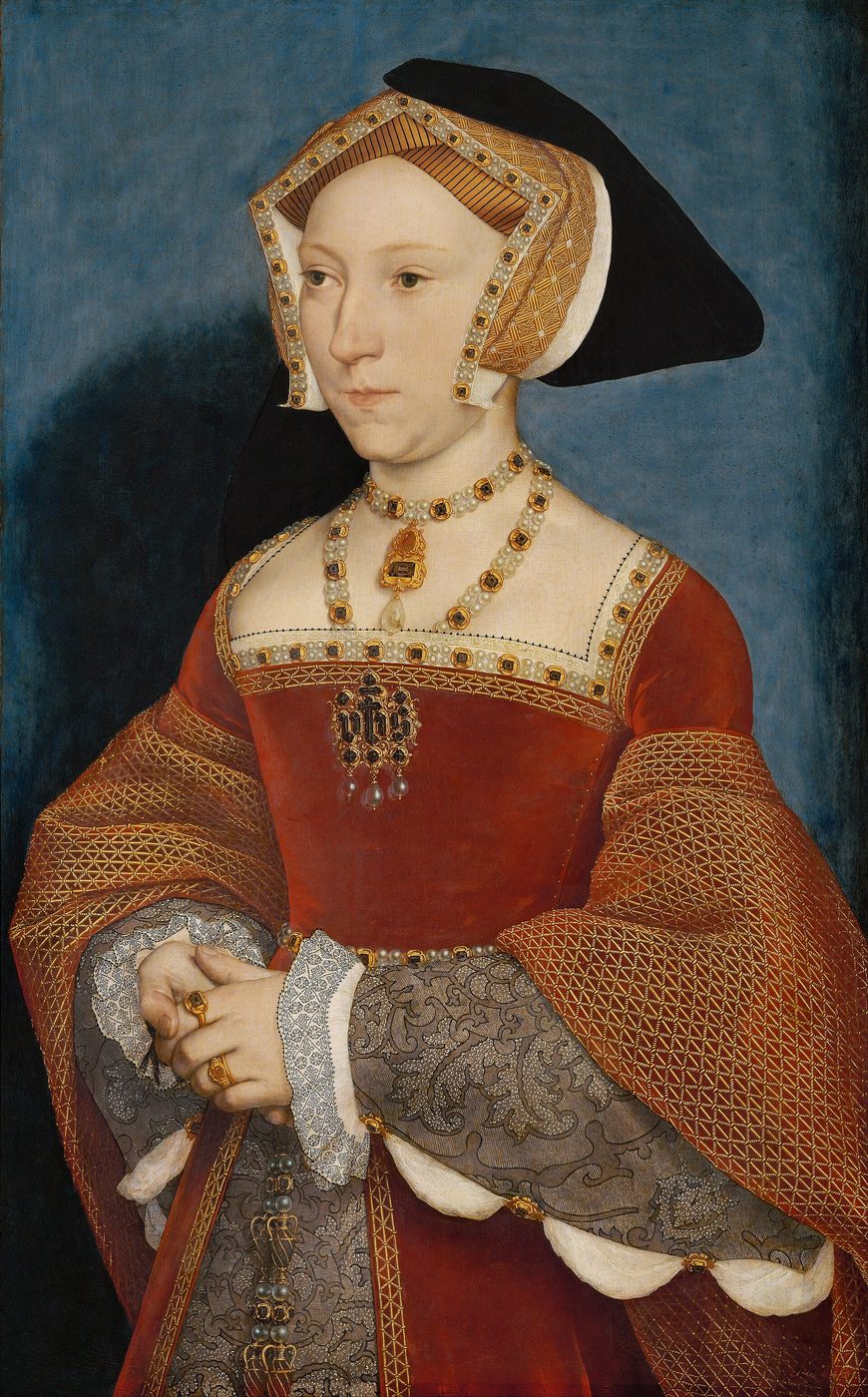
Henry's favorite image of himself also preserved his favorite queen. Jane Seymour died in 1537, shortly after giving birth to his long-awaited son, Edward. She stayed in the Whitehall Mural, standing beside Henry, long after her death, and when Henry died in 1547 he was buried next to her at St George's Chapel, Windsor.
The takeaway
Henry VIII didn't just have portraits; he had a brand. One pose, one painter, endless copies. That's why, five centuries later, you can recognize him in silhouette. For more paintings that bent the truth, read famous paintings that lie to you, or see what happens when we put the old masters to work in our gift shop.
Power pose, approved by the king. Follow @clasycal on Instagram for more royals with something to prove.
Sources
- Portrait of Henry VIII (Holbein) / Whitehall Mural, Wikipedia
- Royal Collection Trust: Henry VII, Elizabeth of York, Henry VIII and Jane Seymour (Remigius van Leemput, 1667)
- Art UK: Henry VIII and Henry VII, Hans Holbein the Younger (NPG 4027)
- Royal Collection Trust: Armour garniture of Henry VIII for the field and tilt (c. 1540)
- History Hit: 10 facts about Anne of Cleves
- The Anne Boleyn Files: Anne of Cleves, the 'Flanders mare'?
- Walker Art Gallery: Henry VIII (after Holbein)