Paintings don't come with a fact-check label. For centuries they were the closest thing to a photograph of history, which is a lot of responsibility for something made with a brush, a deadline and a patron who wanted to look good.
Here are six famous paintings that bend the truth, crop it, move it, or quietly invent it. All of them are still masterpieces. They're just unreliable narrators.
1. Washington Crossing the Delaware: the wrong flag, the wrong light, the wrong boat
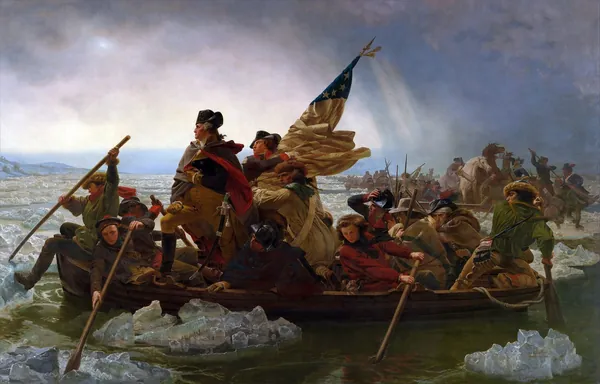
Emanuel Leutze's giant canvas (it's over six meters wide, at the Metropolitan Museum of Art in New York) shows George Washington standing heroically in a small boat, crossing an icy river toward a glowing horizon. It's the definitive image of December 25–26, 1776. It's also wrong in several fun ways.
- The flag didn't exist yet. That's the Stars and Stripes, and Congress only adopted it on June 14, 1777, about six months after the crossing.
- It happened at night. The army crossed in darkness, in a winter storm. Leutze gives us something closer to a dramatic sunrise.
- The boat is too small. The troops used larger cargo boats. Standing up at the front of a crowded rowing boat in an icy current would also be, let's say, a bold leadership choice.
And the painter wasn't there either. Leutze, a German-American artist, painted it in Düsseldorf in 1851, about 75 years after the event. It was never meant as reportage. It was a hero poster.
2. Napoleon Crossing the Alps: he took the mule
Jacques-Louis David's Napoleon Crossing the Alps is peak personal branding: a rearing horse, a billowing cloak, a finger pointing to the summit and, carved into the rocks below, the names Bonaparte, Hannibal and Karolus Magnus (Charlemagne). Subtle.
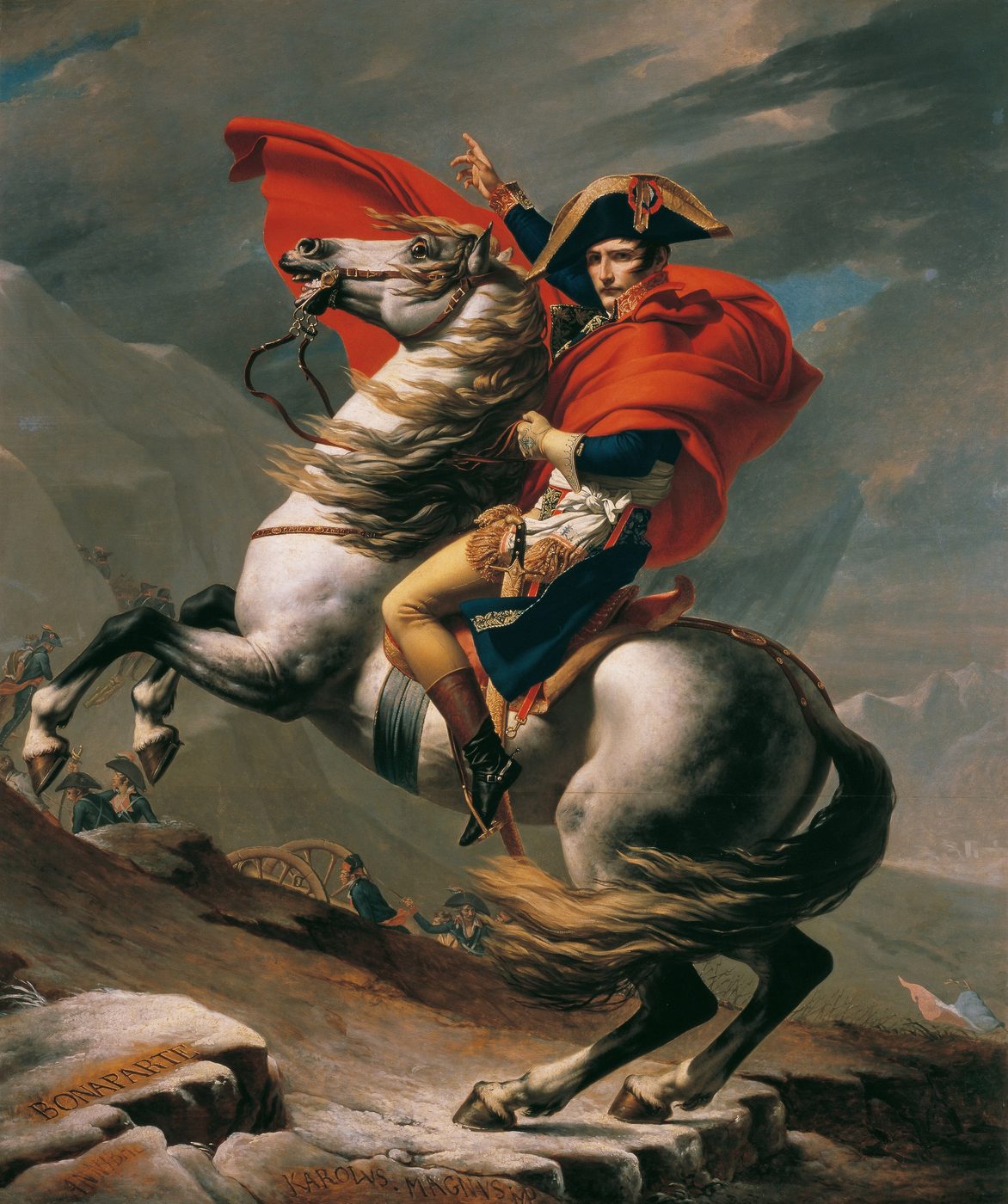
The real crossing of the Great St Bernard Pass in May 1800 was less cinematic. Napoleon rode a sure-footed mule and was led by a local guide, which is exactly what any sensible person would do on an Alpine pass.
He didn't sit for the portrait, either. Napoleon refused point blank, reportedly telling David that a painting should show a great man's character, not his actual face. David worked from a bust and used his own son as a stand-in for the pose. The picture was such a hit that David painted five versions between 1801 and 1805.
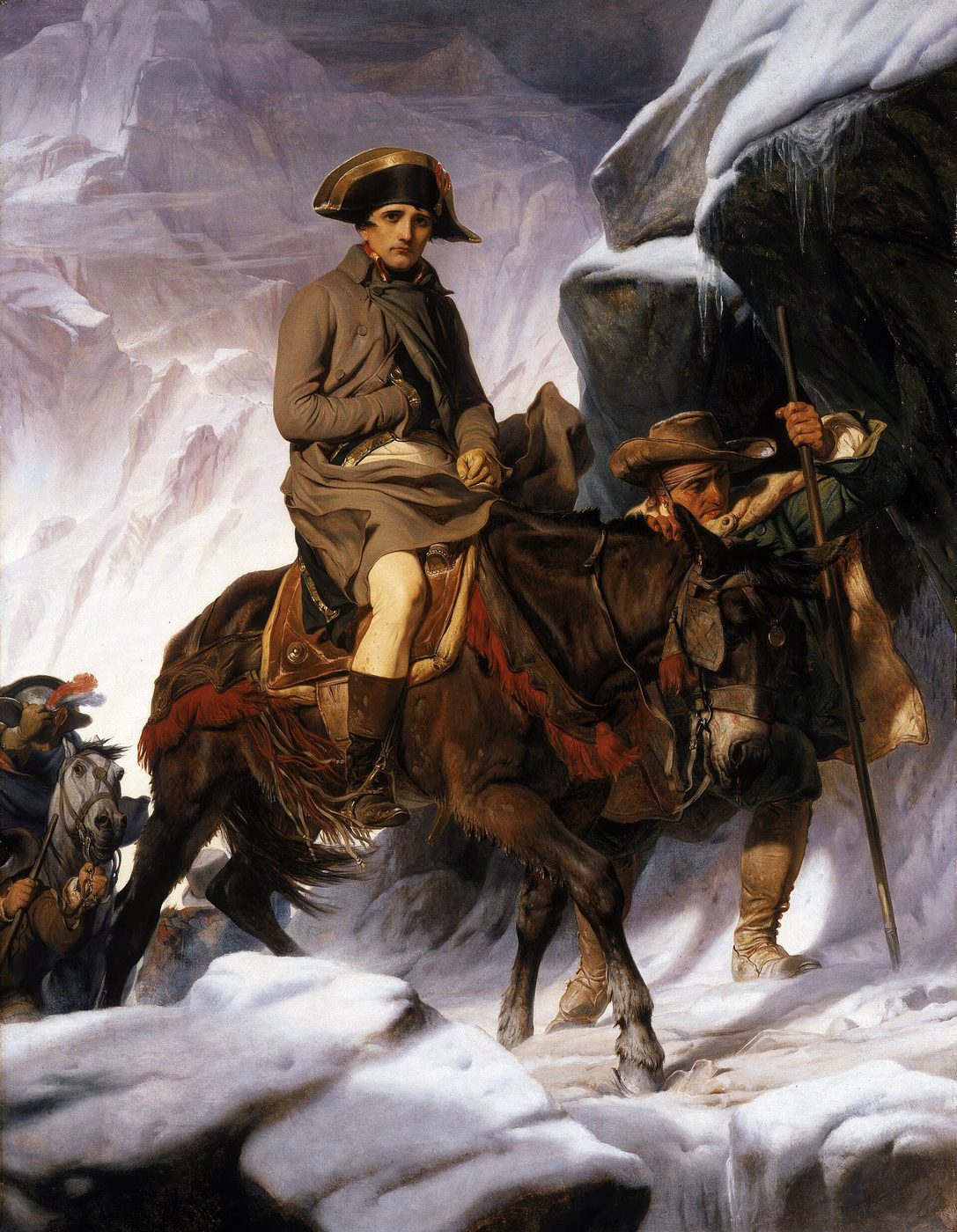
Half a century later, Paul Delaroche painted the honest version. His Napoleon sits hunched on a mule in the snow, wrapped in a grey coat, while a peasant guide leads the animal. Same man, same mountain, completely different press release.
3. The Night Watch: not at night, and not complete
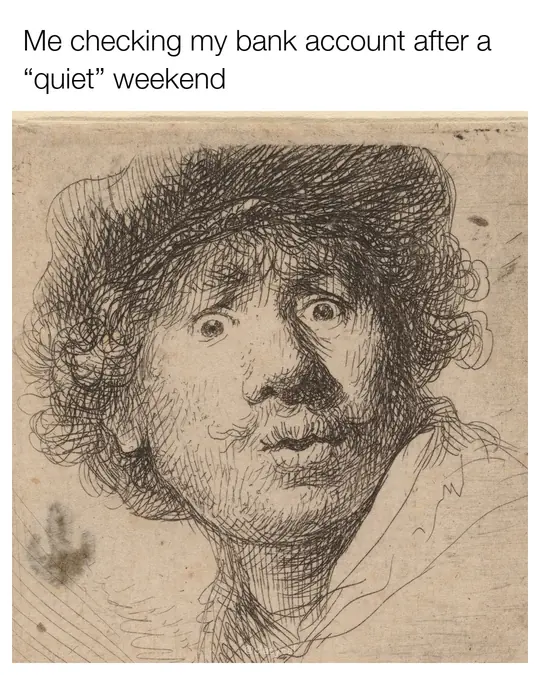
Rembrandt's 1642 group portrait of an Amsterdam militia company is one of the most famous paintings in the world, and both parts of its nickname are misleading.
First, it isn't a night scene. Over time, layers of darkened varnish and grime made the whole picture look as if it took place after dark. The name "Night Watch" first turns up in a document in 1797, more than 150 years after Rembrandt finished it. Its official title is the much less catchy Civic Guardsmen of District II under the Command of Captain Frans Banninck Cocq.
Second, you're not seeing the whole thing. In 1715 the painting was moved to Amsterdam's Town Hall on the Dam, and it was cut down to fit between two doors. Pieces were trimmed from its edges, with the biggest piece taken from the left, and several figures disappeared with them. The missing pieces have never been found.
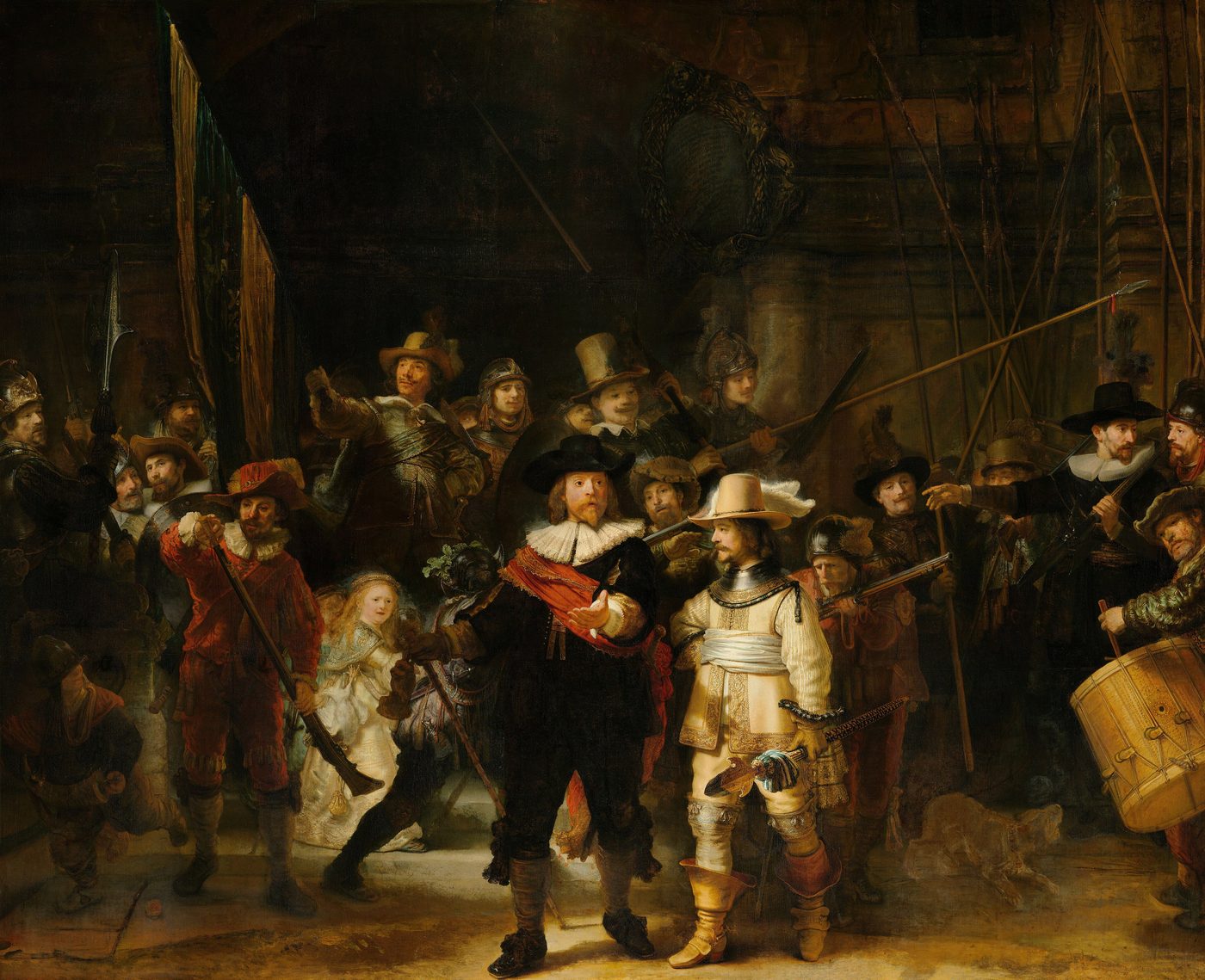
We know what was lost thanks to a smaller 17th-century copy attributed to Gerrit Lundens. In 2021 the Rijksmuseum used it, with the help of artificial intelligence, to print and temporarily hang reconstructions of the missing edges next to the original.
4. The Death of Socrates: a guest who wasn't there
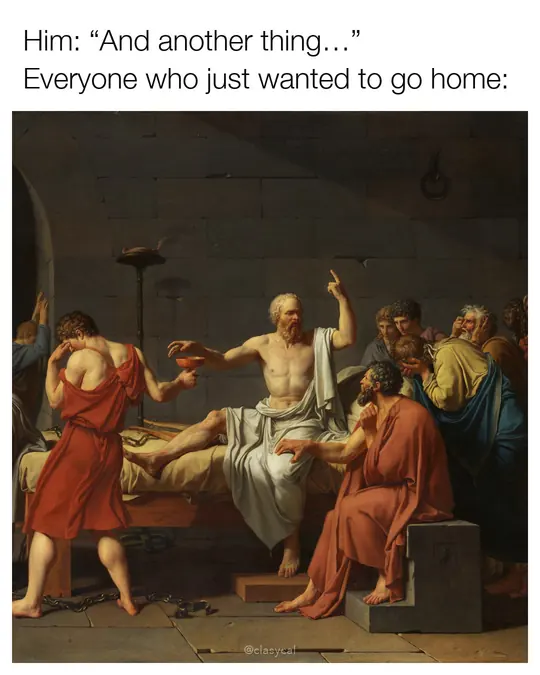
In David's The Death of Socrates (1787, Metropolitan Museum of Art), the philosopher reaches calmly for the cup of hemlock while lecturing his weeping students. At the foot of the bed sits an old man, slumped and turned away. That's traditionally identified as Plato.
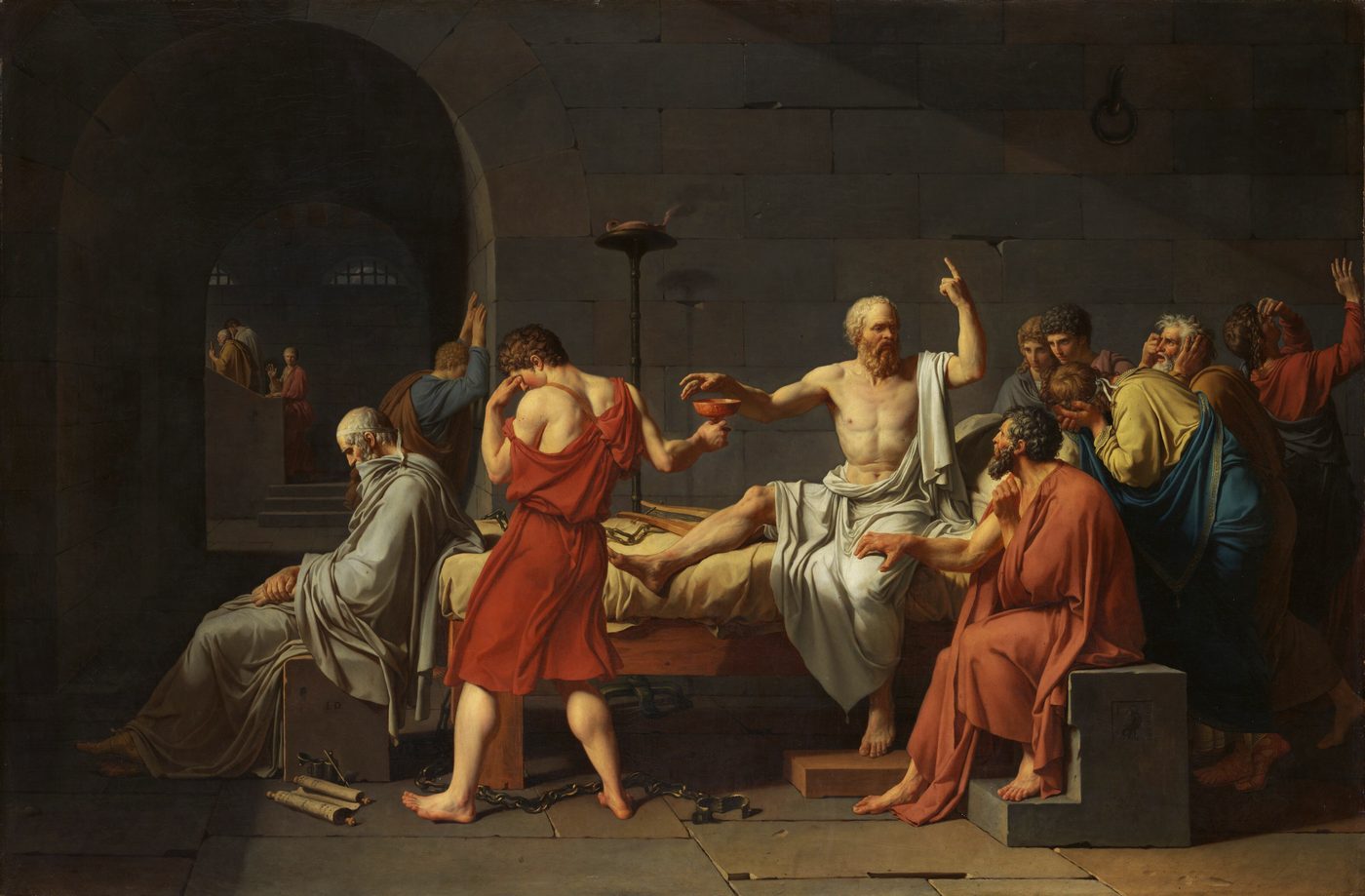
Problem: according to Plato himself, he wasn't there. In the Phaedo, his account of Socrates's last day, the narrator lists who was present and adds that Plato, he believes, was ill. Plato was also not old. He was still in his twenties when Socrates died in 399 BC. Meanwhile Socrates, who was about 70, has the torso of a gym teacher.
David knew his sources. Putting Plato in the scene was an artistic choice: the man who wrote the story gets a seat in it.
5. The Starry Night: the village is made up
Vincent van Gogh painted The Starry Night in June 1889 while staying at the asylum of Saint-Paul-de-Mausole in Saint-Rémy-de-Provence. The swirling sky, the hills and the view are based on what he saw from his east-facing bedroom window.
The village, though, was not in that view. According to the Museum of Modern Art in New York, which owns the painting, the village could not be seen from his window; he added it, drawing on other views. He also painted the picture during the day in his studio, not under the stars, since patients weren't allowed to paint in their bedrooms. The cypress, too, is pulled much closer than it really stood.
It's less a view than a memory with the volume turned up.
6. Hunters in the Snow: Flanders does not have those mountains
Pieter Bruegel the Elder's Hunters in the Snow (1565, Kunsthistorisches Museum, Vienna) is the ultimate cozy-bleak winter painting: tired hunters, a skinny pack of dogs, skaters on frozen ponds. And in the background, a row of jagged, snowy peaks.
The Low Countries, where Bruegel lived and worked, are famously flat. Those crags come from somewhere else entirely. Bruegel had crossed the Alps on his journey to Italy in the early 1550s, and the mountains he saw there turn up in his landscapes for years afterward. Here, they've been transplanted behind a Flemish village like a very ambitious green screen.
The painting was part of a series about the times of the year made for an Antwerp merchant. Five of those panels survive today.
Why painters lied (and why we let them)
None of this was a mistake. Painters were making arguments, not documentaries. Leutze wanted a symbol, David wanted a legend, Van Gogh wanted a feeling, and Rembrandt's painting just had a rough few centuries. The lies are often the most interesting part.
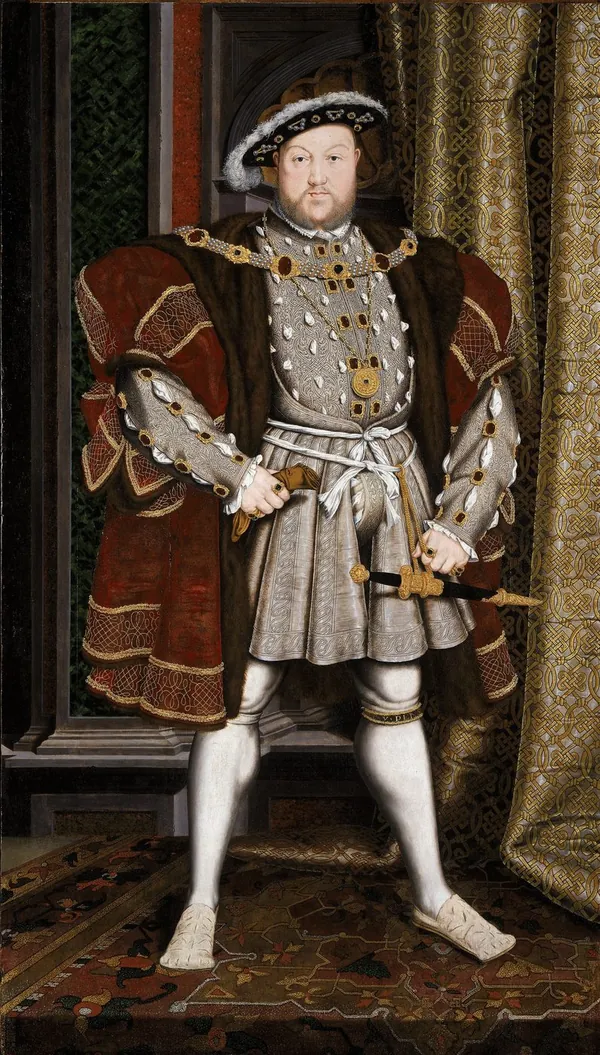
If you liked this, you'll enjoy how Henry VIII used Holbein as his personal PR department, or the gentler fictions in our meme archive.
Still masterpieces. Just with a few edits. Follow @clasycal on Instagram for more paintings that know exactly what they did.
Sources
- The Met: Washington Crossing the Delaware, Emanuel Leutze
- Washington Crossing the Delaware (1851 painting), Wikipedia
- Napoleon Crossing the Alps, Wikipedia
- Bonaparte Crossing the Alps (Delaroche), Wikipedia
- Rijksmuseum: 10 things about Rembrandt's Night Watch
- Rijksmuseum: For the first time in 300 years The Night Watch is complete again (2021)
- The Met: The Death of Socrates, Jacques-Louis David
- Plato, Phaedo 59b (Perseus Digital Library)
- MoMA Learning: Vincent van Gogh, The Starry Night
- The Starry Night, Wikipedia
- Kunsthistorisches Museum: Hunters in the Snow (Winter)
- The Hunters in the Snow, Wikipedia