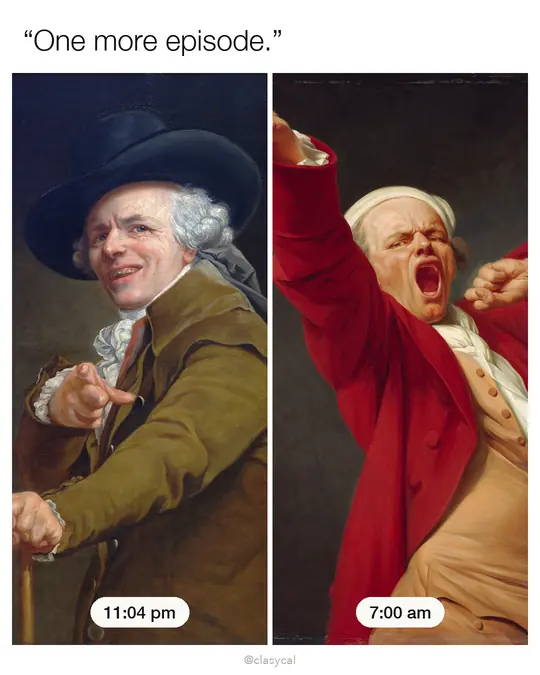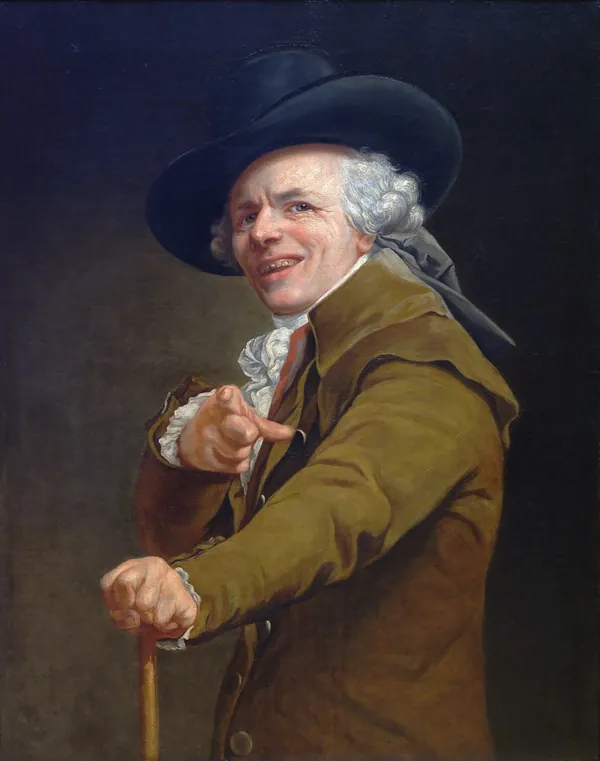
Somewhere around 2009, a man who had been dead for 207 years went viral. He had powdered hair, a velvet coat and a grin that said "I know something about you." He was pointing straight at the viewer. And over his head, in bold white letters, someone had written: Disregard females, acquire currency.
His name was Joseph Ducreux. He was a real 18th-century French painter, a baron, a court artist to Marie Antoinette and, as it turns out, one of the internet's founding fathers.
Who was Joseph Ducreux?
Ducreux was born in 1735 in Nancy, in the Duchy of Lorraine, and trained as a portraitist. He was good at it, and his big break was very much a royal one.
In 1769 he was sent to Vienna to paint a portrait of the young Austrian archduchess Marie Antoinette, who was about to be married off to the future Louis XVI of France. The picture was, more or less, a royal dating profile: a way for the French court to see the bride before she arrived. It went well. Ducreux was made a baron and given the title premier peintre de la reine, first painter to the queen, even though he was never a member of the Royal Academy.
Then the French Revolution happened, which was bad news for anyone with "baron" and "queen" on their résumé. Ducreux spent time in London, returned to Paris, and kept working. He also drew the last portrait of Louis XVI before the king was guillotined in 1793. Later he moved in the circle of Jacques-Louis David, the Revolution's star painter.
He died in 1802, of a stroke, while out on a walk on the road between Paris and Saint-Denis. He left seven children, including the painter Rose-Adélaïde Ducreux.
The man who made faces
Plenty of 18th-century painters made polished portraits of aristocrats. What makes Ducreux different is what he did when no one was paying: he painted himself pulling faces.
Remember, this was an era when a dignified portrait meant a closed mouth and a calm expression (we explain why in why nobody smiles in old paintings). Ducreux ignored all of it. He painted himself yawning, laughing, shushing, looking terrified and, most famously, mocking you.
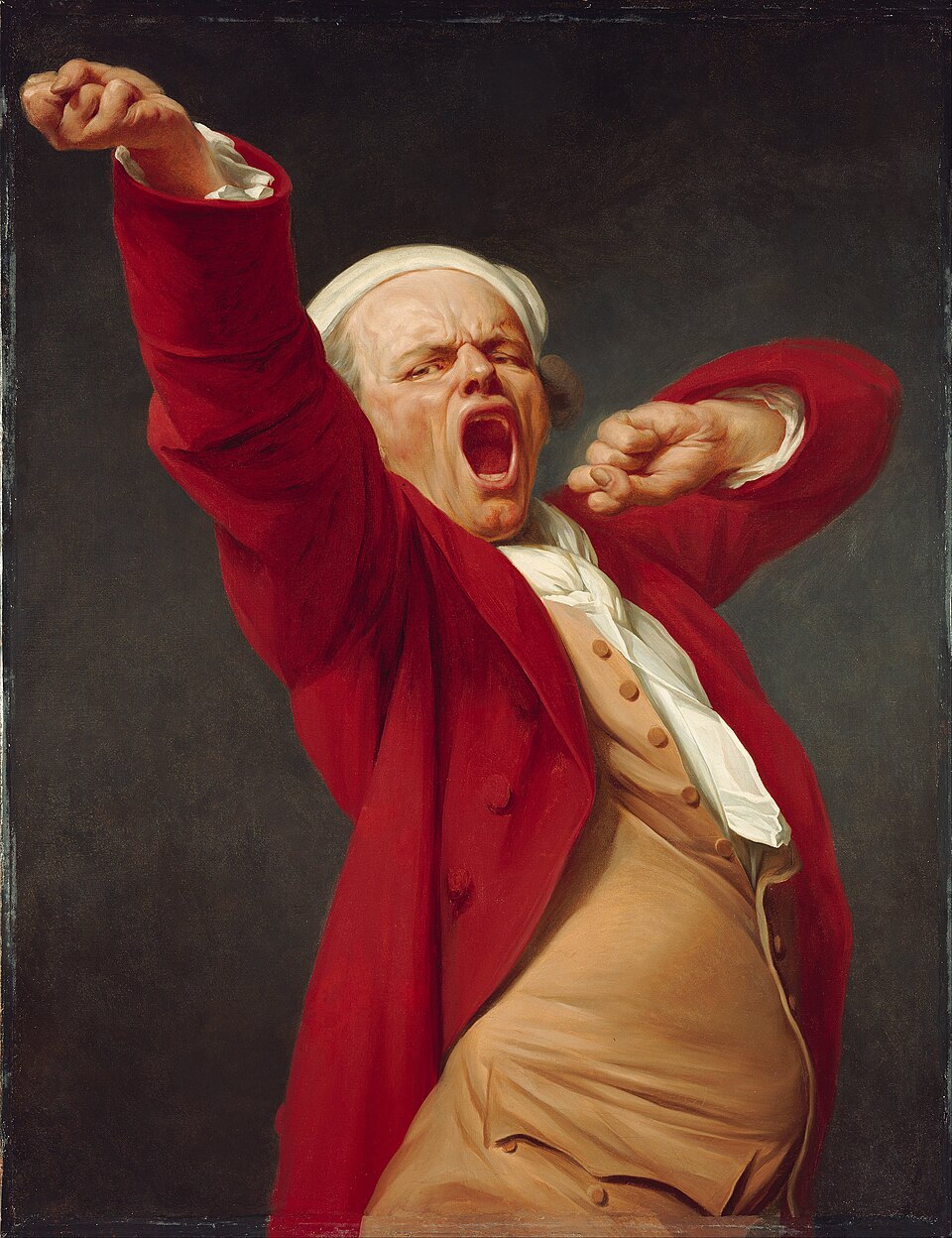
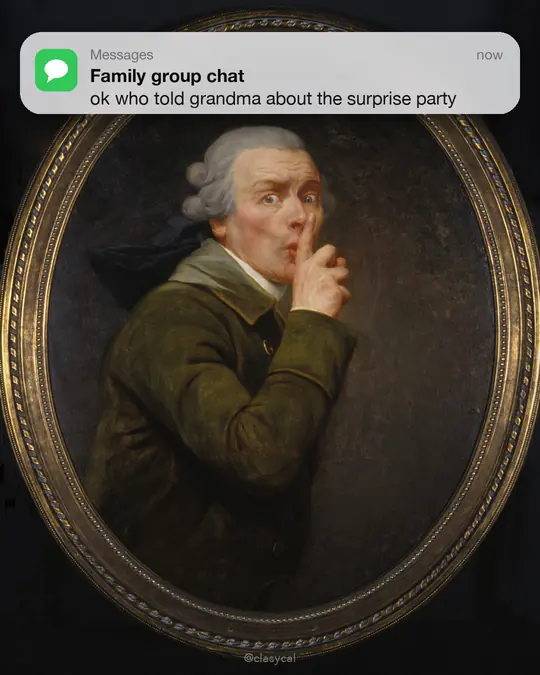
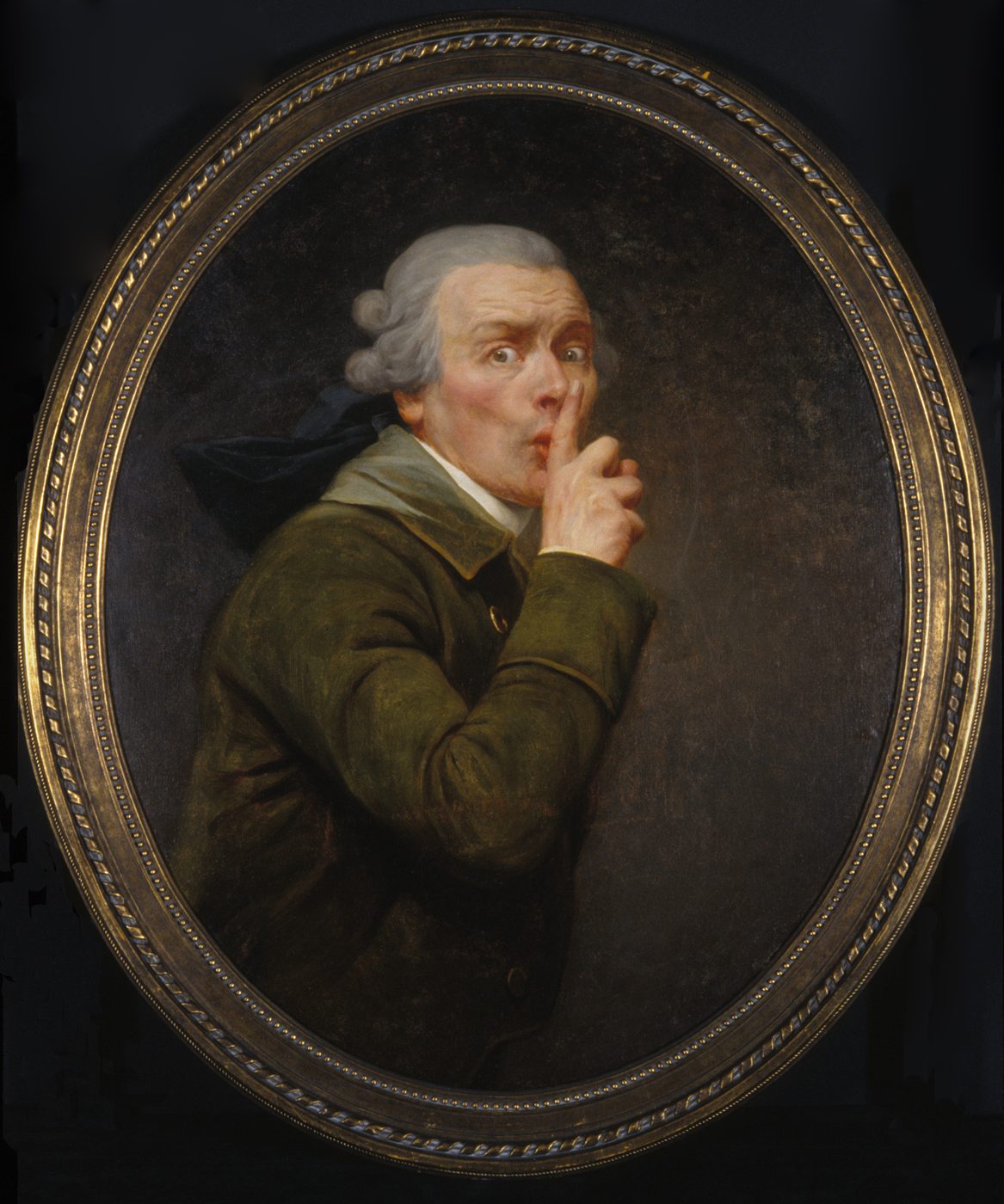
Self-Portrait, Yawning (around 1783, now at the Getty Museum in Los Angeles) shows him in a nightcap, arms stretched, mouth wide open. Le Discret (around 1790, one version is at the Spencer Museum of Art in Kansas) has him raising a finger to his lips in a perfect "shhh." In Self-Portrait as a Mocker, dated around 1793 and now in the Louvre, he grins, leans in and points straight out of the canvas.
These weren't random jokes. Ducreux was fascinated by physiognomy, the then-popular idea that the face and body reveal a person's inner character. His self-portraits were studies of expression, with himself as the most available model. It just so happens that a study of expression in 1790 is a reaction image in 2026.
How a 1790s self-portrait became a 2009 meme
The meme started with the Mocker. Know Your Meme dates its entry for the format to November 2009, and it spread across image boards and meme-generator sites from there. The Public Domain Review also dates the original meme to 2009, with its creator unknown.
The format, usually called "Archaic Rap," is simple and brilliant: take a modern rap or pop lyric, usually crude or boastful, and translate it into the stiffest, most elaborate 18th-century English you can manage. The original, "Disregard females, acquire currency," is a polite rewrite of a much ruder line from "Get Money" (1995), the Junior M.A.F.I.A. track featuring the Notorious B.I.G.
The joke works because of the gap. Gangsta rap braggadocio, rewritten as if by a man who owns a snuff box, delivered by a face that looks like he's genuinely enjoying it. You can practically feel the format writing itself. A quick example in the style:
"I am burdened with ninety-nine difficulties, yet a lady friend is not among them."
Thousands of variations followed, and the format even spun off a version with actor Steve Buscemi's face photoshopped onto the painting, quoting his film lines in the same faux-antique style.
Why Ducreux works better than almost any other painting
- He looks at you. Most portraits gaze politely past the viewer. Ducreux makes eye contact and points. He feels less like a portrait and more like someone in your replies.
- He breaks the rules of his time. An open grin in a formal 18th-century portrait is already a little absurd. The meme just makes the absurdity explicit.
- The face does the work. His expression reads instantly, even as a thumbnail on a phone screen. That's half of what a good meme template needs.
- He's public domain. His paintings are more than 200 years old and free to use, so anyone could remix him. And everyone did.
There's a nice irony here. Ducreux painted these faces to explore how expression reveals character. Two centuries later, millions of strangers used them to express their own characters, one caption at a time. That might be the most successful physiognomy experiment ever run.
Where to see the real Ducreux
If you want to meet him in person, the Mocker belongs to the Louvre and the yawning self-portrait is at the Getty Center in Los Angeles. Seeing them in a gallery is a slightly surreal experience: other visitors look respectful, and you're trying not to say "acquire currency" out loud.
Ducreux also shows up in our own archive, including the meeting that could have been an email. For more about why some paintings become memes and others don't, read the most memed paintings of all time.
Disregard boring feeds, acquire better ones. Follow @clasycal on Instagram, where the old masters still have something to say.
Sources
- Joseph Ducreux, Wikipedia
- The Public Domain Review: Joseph Ducreux's self-portraits
- Know Your Meme: Joseph Ducreux / Archaic Rap
- Google Arts & Culture (J. Paul Getty Museum): Self-Portrait, Yawning, Joseph Ducreux
- Spencer Museum of Art: Le Discret, Joseph Ducreux
- Classic FM: Joseph Ducreux's unorthodox self-portraits make the best classical art memes